
ROBERT SNAP SPOT
Thursday Pine, Sweetwater Creek State Park
Down here, beside the oak leaf

Thursday Tree Love · State Park Adventuring Series

A Flower in the Pine Cone?
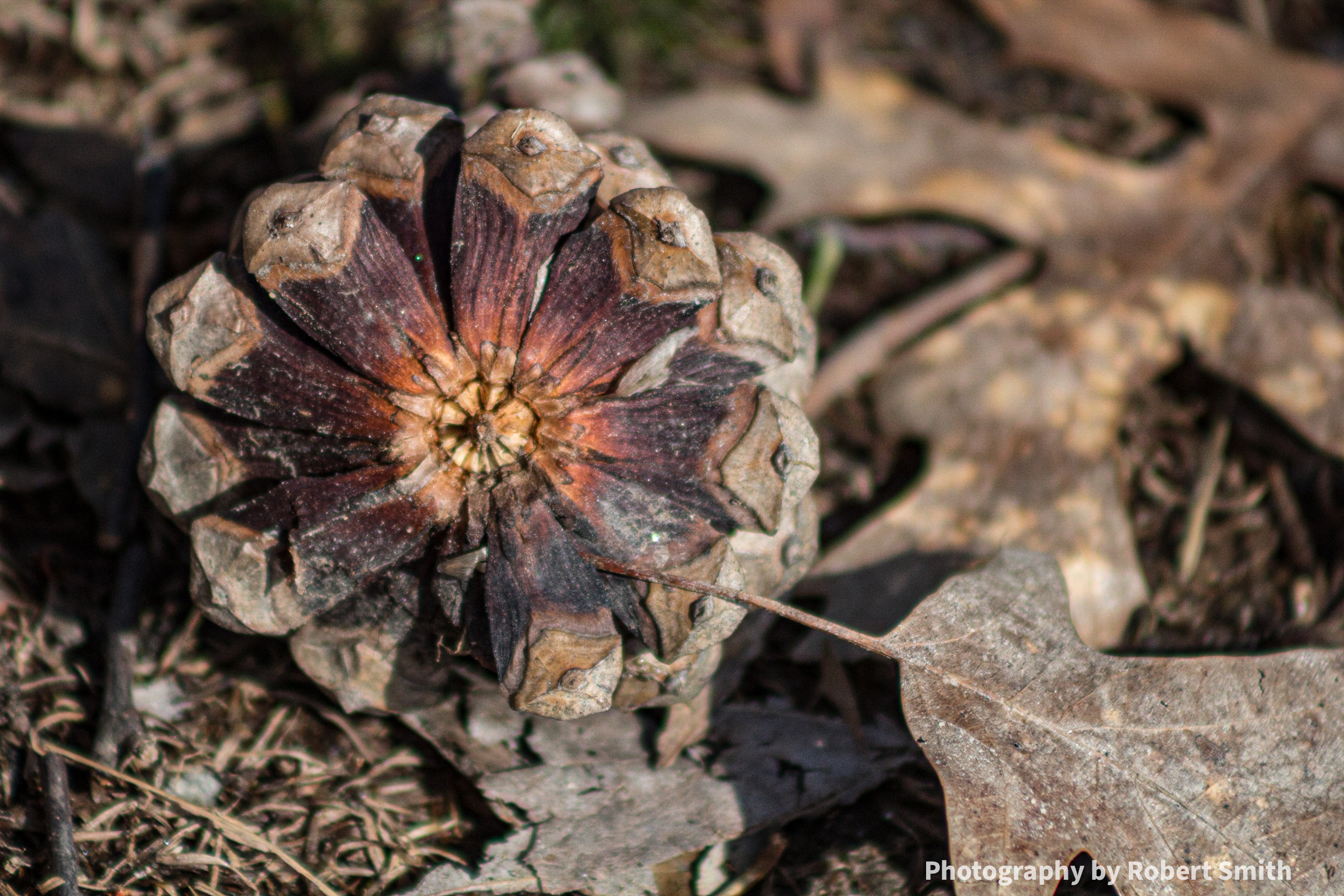
Take a look at the end of this pine cone with me.
Start in the middle and follow one of those reddish-brown scales all the way out.

Now you see why I’m calling those scales petals. I can see a whole flower in there!
And those woody “petals” can still move. On many fallen pine cones, they draw together when damp and spread apart again as they dry. Hey now! When they fell I thought these guys must be dead. How can they open and close then?
A Perfect Pine Cone
From this angle, look for the little point on the end of each scale.

My eye goes from one pale tip to the next, following a diagonal right across the cone.
Three photographs of pine cones, and this is the one that makes me glad I kept looking.
Seen any pine cones lying around?
What to Observe
- Scale movement. Try this with an open pine cone from your yard. Take its picture, set it in a bowl of water, then photograph it from the same angle once the scales have drawn together. Let it dry and take one more. Compare the gaps between the scales in your three photos. Hidabroot’s home experiment
- Age and condition. A seed cone can spend two or three years maturing on the tree, depending on the pine. On the ground, look at the edges. You may find a cone with its tips intact beside one with worn or broken scales.
- Wildlife signs. Keep an eye out for a cone stripped down to its core. A scatter of clipped scales nearby can be a clue that a squirrel has been there for the seeds.

THE CONVERSATION CONTINUES
Nature is Calling!
Walking in a state park in Georgia I’m sure I have seen hundreds of pine cones. Somehow on this day, this one got my attention.
Has something so plain and plentiful ever fascinated you when surely there was nothing particularly special about it?
“Neal and I have come to love our exploration into Georgia’s State Parks”
— Robert
📍Sweetwater Creek State Park, LithiaSprings, Atlanta, Georgia
Collection
Thursday Tree Love, State Park Adventuring Series
Captured with
Canon EOS Rebel SL1
Published by
Robert Snap Spot

Join the Conversation