
ROBERT SNAP SPOT
The Snap Spot Podcast Episode 7: I Love You So Deeply
A family name carved in stone becomes an unexpected reflection on marriage, memory, and love spoken to the living.

Photography Podcast – Cemeteries
See original post > I love you so deeply
A NOTE BEFORE LISTENING:
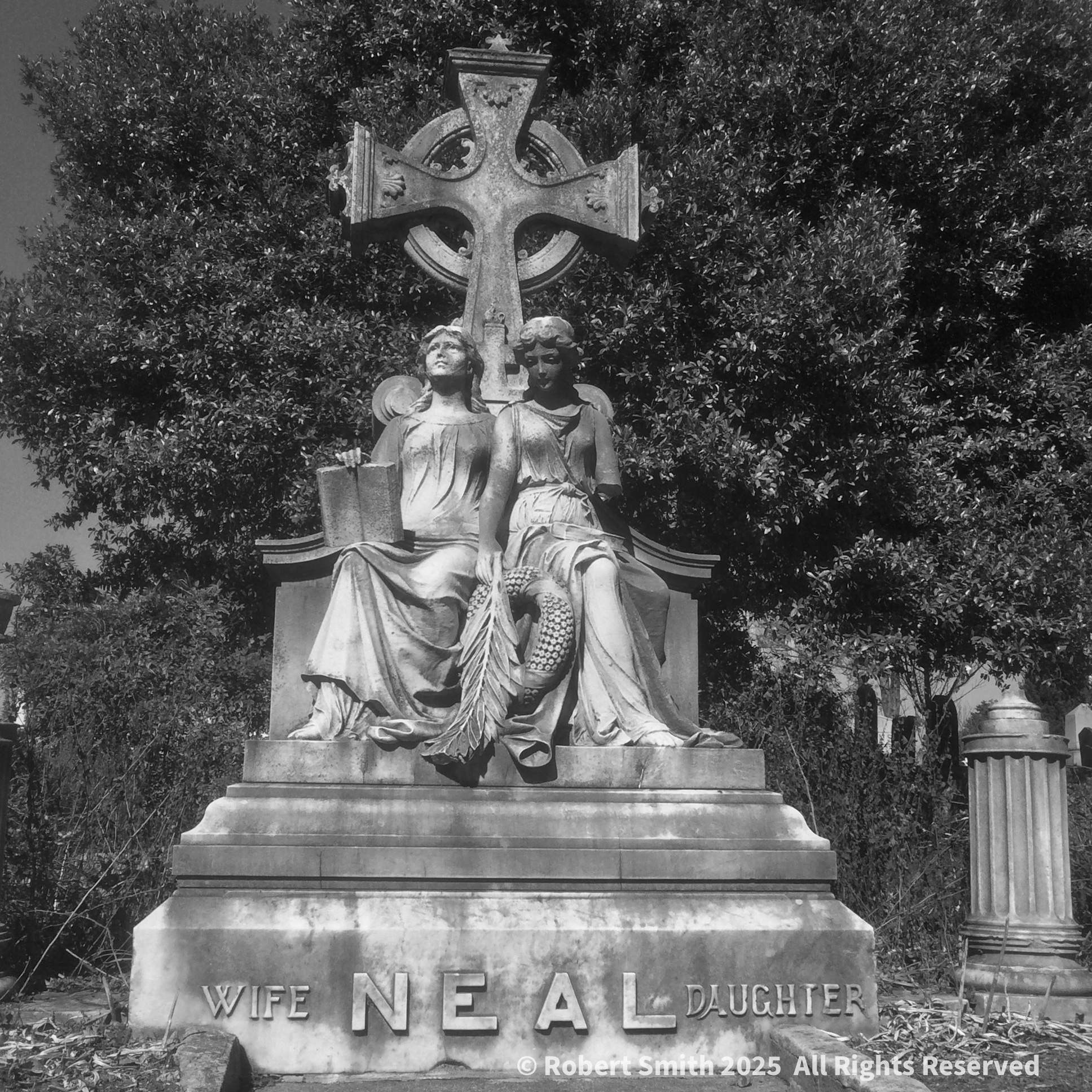
On the monument shown here, NEAL is the surname identifying the family plot. Neal is also the first name of my husband. Seeing his name carved into another family’s memorial caused me to pause and connect their declaration of enduring love with my own marriage.

Walking through Historic Oakland Cemetery, I stopped before a family plot for one simple reason: carved prominently into the monument was the surname NEAL.
On that stone, the name belonged to another family. In my life, Neal is my husband. For a moment, their memorial opened a doorway into my own thoughts about loss, love, legacy, and hope for eternity.

THIS WEEK I NOTICED
Something worth noticing: what a surname can carry
In a cemetery, a surname gathers generations of a family beneath one name.
During my 23 years in the Army, I was often simply called Smith. That was customary among soldiers: a surname became an everyday identity shaped by service, rank, responsibility, and belonging.
On this monument, NEAL identifies a family. To me, it also called forward my husband. The same word carried two entirely different histories, depending on who was looking.
I Love You So Deeply
Pip: Robert Snap Spot — where a walk through a historic cemetery becomes a meditation on love, loss, and the names carved in stone.
Mara: Today we’re looking at work from Robert J Jr., and the territory is intimate: devotion, memory, and what it looks like when a photographer finds poetry in a graveyard.
Pip: Let’s start with the monument that stopped him mid-walk.
Mara: The setup here is a visit to Historic Oakland Cemetery in Atlanta, Georgia — photographs taken on an iPad Air, and a question that arrives almost before the poem does.
Pip: The post opens with that question hanging in the air: “Wait, Neal is that your name on the monument?” — and then the poem follows, as if the stone itself prompted it.


Mara: And the poem is direct. The lines read: “I love you so deeply, I love you so much, I love the sound of your voice and the way that we touch.”
— I Will Love You Forever Poem by I Love My Wife Forever --
I love you so deeply,
I love you so much,
I love the sound of your voice
And the way that we touch.
I love your warm smile
And your kind, thoughtful way,
The joy that you bring
To my life every day.
I love you today
As I have from the start,
And I'll love you forever
With all of my heart.
Pip: That’s a love poem delivered inside a cemetery, which is either a contradiction or the most honest place you could possibly say it.
Mara: It’s the latter, I think. The post frames the cemetery as a place holding loss, love, legacy, and — his word — hope for eternity. The poem isn’t grieving; it’s an affirmation addressed to a living wife, titled “I Love My Wife Forever.”
Pip: So the grave marker belonging to someone named Neal becomes the occasion for declaring love to someone very much still present. The stone is the prompt, not the subject.
Mara: That distinction matters. The photography — shot in Lightroom, artistic cemetery work — is doing the same thing the poem does: finding something durable and luminous in a place most people walk past quickly.
Pip: Oakland Cemetery is one of Atlanta’s oldest, and the monumental stonework there is genuinely striking. The iPad Air framing is worth noting too — this is deliberate artistic photography, not a casual snapshot.
Mara: The post tags it under cemetery photography and artistic photography both, which tracks. It’s sitting at the intersection of elegy and love letter, and the images carry that double register.
Pip: A cemetery as a place where love gets its clearest statement — that’s the idea the whole post is built around.

One figure looks toward what may come next. The other appears to hold what has already been lived. Between them rests the quiet weight of remembrance.
Mara: Legacy carved in stone, love spoken to the living — there’s a lot of quiet weight in that combination.
Pip: Next time, we’ll see where else Robert J Jr. finds that kind of light. Stay with us.
THE CONVERSATION CONTINUES
Before we leave this conversation…
Notice. Remember. Respond.
Have you ever encountered a familiar name in an unexpected place and suddenly felt your own life enter someone else’s story?
“Sometimes a name belongs entirely to strangers—until love teaches us another way to read it.”
— Robert
📍Historic Oakland Cemetery in Atlanta, Georgia
Collection
Cemeteries
Captured with
iPad Air
Published by
Robert Snap Spot

Join the Conversation